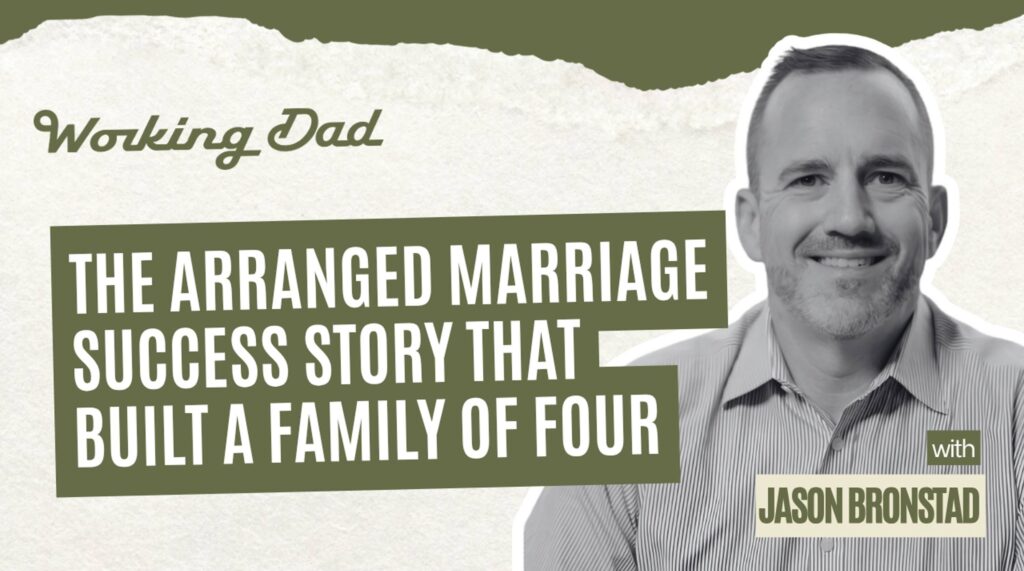
Most love stories don’t start with a mother-in-law on match.com. Jason Bronstad’s does. On this episode of Working Dads, host Johnathan Grzybowski talks with Jason, CEO of Malk Organics, about the “arranged marriage” that built his family of four, the stress he carried for years, and the habits that finally let him show up fully at work and at home.
An “Arranged Marriage,” Courtesy of Match.com
Jason calls marrying his wife “the best decision I’ve ever made in my life,” and he says it was, for all intents and purposes, an arranged marriage. Twenty-three years ago, his future mother-in-law found him on match.com and called her daughter: “I found your husband.” Her response was that there was no way it was happening.
It happened. They’ve been together 23 years and married 21, with two kids: a daughter who just started high school and a 10-year-old son in elementary school. The day they recorded was the kids’ first day of school, and Jason was there for drop-off. He describes his wife as “my bride, my CEO mom, the executive of the household.”
Stewarding Malk, Not Founding It
Jason is quick to set the record straight: “I am the steward of the brand.” He joined Malk five years after it launched. Today the brand is in about 18,000 stores across the US, including Whole Foods, Sprouts, Target, Kroger, Publix, and H-E-B.
The move to Malk grew out of COVID. For seven weeks of lockdown, his in-laws lived with the family, five adults and two kids under one roof. That support gave the couple room to talk about what company he should join next. He knew he was done with beverage alcohol. After years in packaged meats, beverage alcohol, and frozen Italian food, Malk is the first product in his 20-plus-year career that his kids can have as much of as they want, because he knows exactly how it’s made.
Finding a Third Space in Jiu-Jitsu
You have home, and you have work. Jason found his third space in jiu-jitsu, the first place he could go and truly not think about work or stress at home.
For too long, he says, he would “compress, suppress, and repress” his stress, believing that carrying it alone was the role of the man. “That’s a lie that we told ourselves,” he says. Your family can tell when you’re stressed. They know you.
On the mats, losing became learning, and learning to breathe under pressure carried into the boardroom: in a tense board meeting, “I’m not gonna melt, I’m just gonna breathe.”
Your next two or three moves
Jiu-jitsu also changed how he parents and leads. When his son says something that triggers a reaction, Jason now pauses instead of letting his “reptilian brain” take over. When his son tells him he doesn’t like his tone, Jason reminds himself that he wants his son to have a voice instead of bottling things up. At home and at work, the question is the same: how can I calmly respond, and what are my next two or three moves?
The Turning Point: Health, Sobriety, and Self-Love
Johnathan asks whether Jason was more easily agitated before jiu-jitsu. “Yes, one hundred percent,” he says. For most of his life, the only ways he could calm his emotions were alcohol or food. When he started jiu-jitsu, he weighed 320 pounds.
Since then, his family has changed the way they nourish their bodies, and at the time of recording he was about a month away from three years sober.
The bigger shift was internal. If he couldn’t love who he was, he says, there was no way he could show love to others the right way. Now he can tell his kids, “I’m stressed out right now. I need a break.”
“And never forget, more is caught than taught in this world with our kids.”
— Jason Bronstad
When kids see a parent choose to regulate calmly instead of blowing up, he says, it starts a domino effect “in the most beautiful way.”
The Power of a Dad Community
Jason credits a second force in his growth: Front Row Dads, a group whose motto is “family men with businesses, not businessmen with families.” Members share vulnerably, and the support flows both ways. “You give when you can give and you take when you need it.”
Closer to home, his “band” of three local dads meets for breakfast a couple of times a month to talk about life without judgment.
From Breadwinner Mindset to Real Partnership
Jason grew up in a stable home; his parents have been married 53 years. His father left before sunrise and came home for family dinner. Hunting trips with his dad later showed Jason the real man behind the breadwinner.
After a finance degree from the University of Texas business school, Jason carried an all-work mentality into marriage. His wife taught in seven schools in seven years as they followed his career. The “I’m the breadwinner, you take care of the house” mindset lasted until it broke, and they rebuilt their marriage to be more collaborative.
Asking for help was the hardest part. When he admits he’s struggling, he says, his wife “lights up,” because he’s being real with her. His advice to Johnathan, who has a two-year-old and another child on the way: even when your partner isn’t asking, look for one or two things you can do that would really light her up.
Being Present Without a Commute
Jason’s evenings are deliberate: his son’s jiu-jitsu class at five, where Jason helps on the mats, his own class at six, then home for a bite and a calm wind-down. When working from home, he struggled with the lost transition a commute used to provide, so he built his own: changing clothes, taking a shower, or going for a quick 10-minute walk to reset before he shows up as dad. Johnathan admits shutting off is hard for him too.
Advice for New Dads
Jason’s closing advice: don’t wear a mask around your kids. Be authentically you, and acknowledge their emotions, even with a toddler. Try a phrase like, “I can see you’re really frustrated. Do you want a minute to just let it all out?” When his own kids were two and three, he admits, he handed them to his wife because he was too full of his own suppressed emotions.
Then there was the day he sat on the stairs with his four-year-old son and asked, “What do I do that upsets you?” The answer: “Your dad voice.”
“Am I showing up with my dad voice or am I showing up to support this human that is trying to figure out who they are?”
— Jason Bronstad
Key Takeaways
- A strong, supportive partnership is the foundation for everything else.
- Find a “third space” outside work and home where you can unload stress.
- Kids learn more from what you model than from what you say.
- A community of dads offers support you can give and receive.
Frequently Asked Questions
Who is Jason Bronstad?
Jason Bronstad is the CEO of Malk Organics. He joined the brand five years after it launched and describes himself as its steward rather than its founder.
How did Jason Bronstad meet his wife?
His future mother-in-law found him on match.com and told her daughter she’d found her husband. Jason calls it, for all intents and purposes, an arranged marriage.
How does Jason Bronstad manage stress as a CEO and dad?
He found a “third space” in jiu-jitsu, gave up drinking, leans on his Front Row Dads community, and uses simple transition rituals, like a shower or a short walk, to reset before family time.
What is Jason’s advice for new fathers?
Don’t wear a mask around your kids. Be authentic, acknowledge their emotions, and pay attention to whether you’re showing up with your “dad voice” or as support.
Watch the Full Episode
Watch Johnathan Grzybowski and Jason Bronstad’s full conversation on YouTube, and subscribe to Working Dads for more honest conversations with dads balancing ambitious careers and family life. If this episode hit home, share it with a dad who needs to hear it.